
English| EUR
Suggested for you
More currencies
Choose a language
Costa Adeje sits at sea level; the Teide cable car base station sits at roughly 2,356 metres. Between the two lies a climb of well over two thousand vertical metres, a choice of three mountain roads, and a set of timing decisions that shape everything else. This how to get to mount teide from costa adeje guide sets out what the journey actually involves before you turn the key.
Quick answer
The drive from Costa Adeje covers roughly 45–60 km and takes about 60–75 minutes, ending at Crta. TF-21, km 43, 38300 La Orotava. Entry to Teide National Park is free, and the park's visitor infrastructure runs 09:00–17:40 daily. Aim to arrive between 09:00 and 11:00; later arrivals meet fuller car parks and thicker cloud on the ascent.
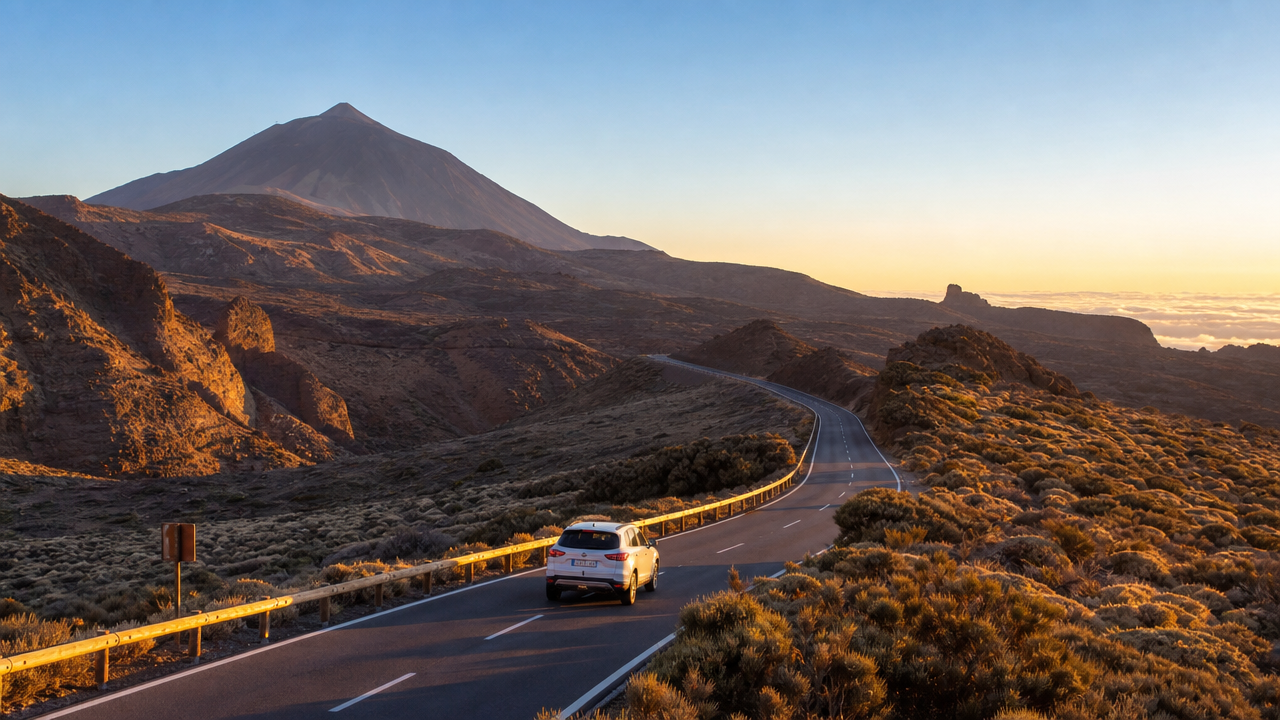
Teide National Park receives more visitors each year than many European countries receive tourists in total, yet almost none of them arrive on foot. The volcano's caldera floor sits above the trade-wind cloud layer, which means the journey up is less a commute than a passage through weather systems. Drivers leaving the coast in bright sunshine frequently pass through a band of grey mist somewhere above Vilaflor, then break out into hard, clear light near the treeline. Understanding that transition is the practical core of any answer to how to get to mount teide from costa adeje, because it explains why the same road can feel entirely different at 09:00 and at 15:00. The geography is simple enough. Costa Adeje occupies the island's south-western coastal shelf. The volcano stands at the centre of Tenerife, ringed by the Las Cañadas caldera, with the TF-21 running north through Vilaflor and past the Roques de García rock formations to the cable car base station and, beyond it, the Parador. Two other approaches exist — one climbing from the west through Chío on the TF-38, another descending from the north via La Orotava — and each meets the TF-21 at a different point. Which one suits a traveller depends less on distance than on where they intend to stop: Mirador de Chipeque and the Minas de San José each sit on different arms of the network. Altitude is the variable most first-time visitors underestimate. The ascent gains more than 2,000 metres in under an hour of driving, and temperatures at the base station commonly run ten to fifteen degrees below coastal readings even in August. Summit access above the cable car's upper station requires a separate permit arranged well in advance, which is a decision made weeks before departure rather than on the morning itself. Car sickness on the switchbacks is common; fuel stations above Vilaflor are not. What to do with all this is straightforward. Treat the Teide excursion as a half-day minimum, not an add-on to a beach morning. Decide in advance whether you are driving yourself, joining an organised Teide tour from the south, or booking a guided buggy route through the volcanic landscape, because each sets its own departure time and each handles the parking problem differently. Anyone still weighing how to get to mount teide from costa adeje should settle the transport question first — the rest of the itinerary follows from it, not the other way round.
“The volcano sits above the cloud layer, which makes the drive less a commute than a passage between two climates.”
Mount Teide is located in the center of Tenerife, accessible primarily via the TF-21 road. Driving from Costa Adeje is the most direct method to reach the base station area.
TF-21 via Vilaflor
Titsa line 342 from Costa Adeje station
Direct route via TF-21
For those driving, navigate to Crta. TF-21, km 43, 38300 La Orotava. Plan to arrive between 09:00 and 11:00 to manage parking availability at the base station.
The best arrival window for Mount Teide is 09:00–11:00 to avoid mid-day crowds and ensure better parking availability at the base station. Planning your departure from Costa Adeje to coincide with this window requires accounting for the drive time, typically starting your journey early in the morning.
—
Arrive early to secure parking and experience lower congestion levels before tour buses arrive.
Cooler, potential snow at summit
Winter months offer clear skies, though temperatures at the summit remain low.
Mild temperatures (15°C–20°C)
These shoulder months provide comfortable hiking weather and fewer crowds than summer peak periods.
Warm temperatures (20°C–25°C)
Expect heavy traffic and crowded conditions, making the 09:00–11:00 arrival window essential for parking.
Verdict: The optimal time to visit is Tuesday to Thursday, arriving between 09:00 and 11:00 during the months of April or October.
Mount Teide operates on a consistent daily schedule throughout the week. Planning your return trip according to these hours is necessary for all visitors traveling from Costa Adeje.
Access to Teide National Park is free of charge for all visitors. Any associated costs depend on whether you choose to utilize the cable car or require a permit for summit access.
Verdict: While park entry is 0 EUR, total costs typically depend on your decision to purchase cable car tickets or obtain a restricted-access summit permit.
Teide sits above 2,000 m, so a little preparation weeks ahead makes the day at the volcano far smoother.
Everything you need to know about how to get to mount teide from costa adeje
To reach the park by car, take the TF-21 road heading inland from the coast. The drive typically takes about 60 to 90 minutes depending on traffic and your starting point in the resort area.
Many visitors choose a guided excursion to simplify logistics and navigation through the winding mountain roads. Private transfers or organized tours often include pick-up services, which helps when planning how to get to mount teide from costa adeje.
Entry to Teide National Park is 0 EUR. However, please note that using the cable car or obtaining access to the summit requires separate permits or tickets that involve costs.
The best arrival window is 09:00–11:00 to avoid mid-day crowds and ensure better parking availability at the base station. Arriving early provides a more relaxed experience at this high-altitude destination.
Public transport options are limited and often require multiple connections, making private vehicles or tours more efficient for those wondering how to get to mount teide from costa adeje. Always check the current bus schedules if you decide to rely on the local TITSA network.
Visitors should prepare for changing weather conditions, as temperatures at the crater can be significantly lower than on the coast. Wearing layers and sturdy footwear is recommended for exploring the volcanic terrain.
Accessing the summit usually requires a specialized permit issued by the national park authorities. You should arrange this well in advance if you plan to hike to the peak, as these permits are strictly limited.
Yes, this iconic landmark is accessible throughout the week. Whether you arrive via a structured excursion or your own vehicle, the national park offers extensive trails and vistas for all visitors.